Guide to restaurant GST
GST for restaurants in India, explained for owners
Updated · 10 min read · By the AirQR team
A standalone restaurant in India charges GST at 5% (2.5% CGST plus 2.5% SGST) with no input tax credit. Restaurants inside hotels with room rates above Rs 7,500 a day charge 18% with credit. This guide covers the rate, Swiggy and Zomato orders, the composition scheme, e-invoicing, what a bill must show and what GST billing software should do. This guide is general information, not tax advice. Check with your CA.
- The 5% rate and the hotel rule
- Swiggy, Zomato and composition
- What a GST bill must show
What is the GST rate on restaurant food?
For a standalone restaurant, café, sweet shop or takeaway counter, the GST rate on restaurant service is 5%. It is split as 2.5% CGST and 2.5% SGST, and you cannot claim input tax credit on what you buy. Input tax credit means setting off the GST you paid on purchases against the GST you collect. At 5% without credit, the tax you charge is a final cost for the guest and you cannot offset your purchases against it.
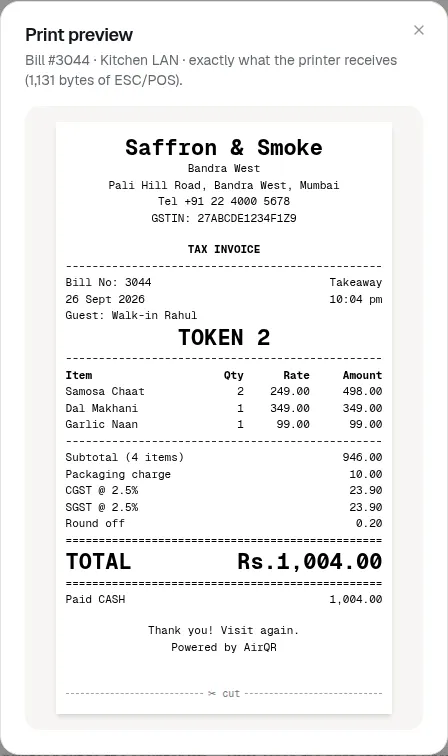
Here is an illustrative example. A table orders food worth Rs 1,000 before tax. At 5% the GST is Rs 50, shown as Rs 25 CGST and Rs 25 SGST, so the guest pays Rs 1,050 before any round off. The Rs 50 goes to the government, and the restaurant keeps Rs 1,000.
The big GST rationalisation of 22 September 2025, often called GST 2.0, did not change this rate for standalone restaurants. The GST Council also added explanations so that a standalone restaurant cannot declare itself a hotel-type premises to choose 18% with credit.
This guide is general information, not tax advice. Check with your CA.
GST rates for restaurants and hotels at a glance
The rate depends on where the service is supplied, not on what the guest eats. Check the notes with your CA before you set up your bills.
- Standalone restaurant, café or takeaway
- GST rate5% (2.5% CGST and 2.5% SGST)
- Input tax creditNo
- In shortThe common case for most Indian restaurants
- Restaurant inside a hotel where a room was supplied above Rs 7,500 a day in the previous year
- GST rate18%
- Input tax creditYes
- In shortApplies to premises defined as specified premises
- Outdoor catering at non-specified premises
- GST rate5%
- Input tax creditNo
- In shortCatering done at the customer's venue
- Outdoor catering at specified premises (hotels)
- GST rate18%
- Input tax creditYes
- In shortSame hotel rule as above
- Hotel room up to Rs 7,500 a day (from 22 September 2025)
- GST rate5%
- Input tax creditNo
- In shortEarlier this band was 12% with credit
- Hotel room above Rs 7,500 a day
- GST rate18%
- Input tax creditYes
- In shortUnchanged
- Restaurant orders through Swiggy or Zomato
- GST rate5%, paid by the aggregator
- Input tax creditNot applicable to you
- In shortSection 9(5) of the CGST Act, from 1 January 2022. Restaurants at specified premises, such as hotels, are left out
- Composition scheme restaurant
- GST rate5% of turnover
- Input tax creditNo
- In shortOnly up to the turnover limit, with a bill of supply
- Alcoholic liquor for drinking
- GST rateOutside GST
- Input tax creditNot applicable
- In shortTaxed by the state as VAT or excise
Sources are the GST Council, CBIC notifications and CBIC FAQs listed at the end of this page. Rates and rules can change, so confirm the current position with your CA.
When does the hotel rule apply, and what is 18% with credit?
Some restaurants charge 18% with input tax credit instead of 5%. This is the rule for restaurants inside specified premises, which in practice means hotels with expensive rooms. Since 1 April 2025, a premises counts as specified premises if any unit of accommodation was supplied at a value above Rs 7,500 per unit per day in the previous financial year. A premises can also be one that chose this status by declaration, or a new registrant that made the declaration.
If you run a restaurant inside a hotel, your CA will know whether your premises is covered. If you run a standalone restaurant, the 5% rate applies and you cannot switch to 18% with credit. That choice was closed by the clarification that came with GST 2.0, effective from 1 April 2025.
One more point for readers who run a hotel. From 22 September 2025, rooms with a value up to Rs 7,500 a day are taxed at 5% without credit, and rooms above Rs 7,500 stay at 18% with credit. This affects the hotel itself, so please check the details for your property with your CA.
GST on food delivery from Swiggy and Zomato
Since 1 January 2022, the e-commerce operator pays the GST on restaurant service supplied through its platform. This is Section 9(5) of the CGST Act. For Swiggy and Zomato orders, the aggregator pays the 5% GST to the government, even if the restaurant is not registered for GST. Cloud kitchens are covered by this rule. Restaurants inside specified premises, such as hotels, are left out of it.
In plain words, you do not charge or pay GST yourself on the part of your sales that came through the aggregator. The operator no longer collects tax at source or files the older return for these supplies. Your CA decides how these sales appear in your own returns. Aggregators also charge you a commission, which is a separate matter from GST.
Orders you take on your own, such as dine-in, your QR menu, a phone call, your own website or your own riders, are not under Section 9(5). On those orders your restaurant is the supplier, so you charge the 5% yourself. This is why many owners track platform sales and direct sales separately. Our guide to zero commission online ordering covers the business side of that split.
Composition scheme for restaurants
The composition scheme is a simpler way to pay GST for small businesses. Under this scheme, restaurant service is the one service allowed. You pay 5% of your turnover (2.5% CGST and 2.5% SGST) with no input tax credit. The turnover limit is generally Rs 1.5 crore in the previous financial year, and it is lower, Rs 75 lakh, in some special-category states. Confirm the limit that applies in your state with your CA.
There are conditions. You cannot collect GST from customers, so you issue a bill of supply instead of a tax invoice. That bill must carry the words composition taxable person, not eligible to collect tax on supplies. You must also show composition taxable person on your signboard. Reading of the rules suggests that selling alcoholic liquor rules out the scheme, so ask your CA if you serve drinks.
Composition suits a small restaurant with simple purchases. It does not suit one with B2B customers who want to claim credit on your tax, because you cannot charge tax. Whether composition is right for you depends on your turnover, your state and your customers, so this is a question for your CA. If you are on composition, check with your billing software maker that it can print a bill of supply. AirQR's help pages describe tax invoices, not bills of supply, so ask AirQR support before you start.
Do restaurants need e-invoicing?
For most restaurants, no. E-invoicing is mandatory for registered businesses whose turnover has been above Rs 5 crore in any financial year since 2017-18, effective 1 August 2023. It applies to business-to-business invoices, debit and credit notes and exports. Ordinary bills to walk-in guests without a GSTIN are business-to-consumer bills, and they are outside e-invoicing.
A dine-in or delivery bill to an unregistered customer does not need an e-invoice. A B2B invoice with a customer's GSTIN, such as for corporate catering, does need one if your turnover crosses the limit. If you are near that line, ask your CA whether your corporate bills need to be reported.
What must a GST bill for a restaurant show?
A tax invoice under the GST rules needs these details. Your billing software should print them for you, and your CA can confirm the exact format.
- Your name, address and GSTIN
- A serial number of up to 16 characters that is unique for the financial year
- The date of the bill
- The customer's name, address and GSTIN, if the customer is registered
- Name and address details of an unregistered customer only if the taxable value is Rs 50,000 or more, or if the customer asks
- The HSN or SAC code, and restaurant service uses SAC 996331
- A description of the supply and its total value
- The taxable value after discount
- The tax rate and amount, shown as CGST and SGST
- The place of supply and state code, for sales to another state
- Whether tax is payable on reverse charge
Bill of supply, small bills and liquor
A composition restaurant issues a bill of supply, which shows the supplier's name, address and GSTIN, a serial number, the date, the recipient's details if registered, the HSN or SAC code, a description and the value of supply after discount. It shows no tax. An invoice or bill of supply need not be issued when the value is under Rs 200, subject to conditions such as the customer not asking for one.
Alcoholic liquor for human consumption is outside GST under the Constitution and Section 9(1) of the CGST Act. States tax it through VAT and excise. A bar or restaurant that sells both charges GST on the food and soft drinks and state VAT on liquor, often on the same bill. Rates and the value they apply to differ by state, so confirm yours with your accountant.
What is GST billing software for a restaurant?
GST billing software prints a correct tax invoice for every order, and then turns your bills into the files your CA needs each month. A good one prints your GSTIN, applies CGST and SGST on every item, numbers bills in a running series and keeps cancelled and refunded bills traceable. It then produces your return data without retyping.
AirQR prints a tax invoice with your GSTIN and CGST and SGST lines. Its GST and accounts page prepares GSTR-1 files from your settled bills, with B2CS, an HSN summary and documents issued, plus a sales register and a check that every bill adds up. See GST billing for the full list.
- SAC 996331 is set by default for restaurant service, and you can change it for bars or outdoor catering
- Refunds are taken off the month in which they were given
- Liquor and tax-free items can sit in their own tax classes outside GST
- Swiggy and Zomato orders are not in AirQR's bills, because the aggregator pays the GST on them
How to set up GST billing for your restaurant
A short checklist for the first month, whichever software you use.
- 01
Confirm your rate and scheme with your CA
Standalone restaurants are normally at 5% without credit. Ask whether you are on the regular scheme or composition, and whether you sell liquor.
- 02
Enter your GSTIN and tax setup
Add your GSTIN and CGST and SGST rates once, so every bill carries them. In AirQR this is under outlet settings. See Outlet settings.
- 03
Set up liquor separately if you sell it
Give drinks their own tax class so state VAT stays apart from GST. See Tax classes and liquor VAT.
- 04
Run a test month with your CA
Download the GSTR-1 files for the first month and let your CA review them before filing. See GST reports and Tally export.
What GST software cannot do for you
Software does not decide your GST rate. It prints what you set up, so the rate, the scheme and the treatment of liquor remain decisions for you and your CA. AirQR says the same in its own help pages, and its files are prepared to save retyping and are not tax advice.
GST rules, notifications and court decisions change. The facts here were checked against the sources below on 10 October 2026. Before you act on any of them, confirm the current position with your chartered accountant. This guide is general information, not tax advice. Check with your CA.
Questions
What is the GST rate on restaurant food in India?
A standalone restaurant charges 5% GST, split into 2.5% CGST and 2.5% SGST, with no input tax credit. Restaurants inside hotels with room rates above Rs 7,500 a day charge 18% with credit.
Did GST 2.0 change the GST rate for restaurants?
No. The 22 September 2025 changes did not alter the 5% rate for standalone restaurants. They did add clarifications so that a standalone restaurant cannot choose the hotel-type 18% rate.
Who pays GST on Swiggy and Zomato orders?
The aggregator pays the 5% GST on restaurant service supplied through its platform, under Section 9(5) of the CGST Act, even if the restaurant is unregistered. Orders you take directly are your own supply and you charge GST on them.
What is the composition scheme for restaurants?
It lets a small restaurant pay 5% of turnover with no input tax credit. The turnover limit is generally Rs 1.5 crore in the previous year, lower in some states, so confirm it with your CA. You issue a bill of supply and cannot charge GST to customers.
Do I need e-invoicing for restaurant bills?
Not for ordinary bills to walk-in customers, which are business-to-consumer. E-invoicing applies to B2B invoices when your turnover has been above Rs 5 crore in any financial year since 2017-18.
Does GST apply to liquor served in a restaurant?
No. Alcoholic liquor for drinking is outside GST and states tax it through VAT or excise. The food on the same bill is still taxed under GST.
What is GST billing software for a restaurant?
It prints correct GST tax invoices and prepares return data from your bills, so your CA does not retype them. See AirQR GST billing for how AirQR does this.
Sources
- GST Council press release, 56th meeting (PIB) · checked 10 October 2026
- CBIC FAQ on restaurant service at specified premises · checked 10 October 2026
- Notification 05/2025-Central Tax (Rate), specified premises · checked 10 October 2026
- Notification 15/2025-Central Tax (Rate), 17 September 2025 · checked 10 October 2026
- CBIC Central Tax (Rate) notifications index · checked 10 October 2026
- ClearTax on GST for restaurant services through e-commerce operators · checked 10 October 2026
- CBIC FAQ on the composition levy · checked 10 October 2026
- CBIC press release on composition scheme changes · checked 10 October 2026
- Notification 14/2019-Central Tax (reproduction) · checked 10 October 2026
- GST Council on e-invoicing thresholds · checked 10 October 2026
- Fiscal Zenith on e-invoicing applicability · checked 10 October 2026
- Rule 46 of the CGST Rules, tax invoice · checked 10 October 2026
- GST Council flyer on tax invoice and bill of supply · checked 10 October 2026
- Explanatory note on SAC 996331 for food supply (VAT Update) · checked 10 October 2026
- Advance ruling quoting Article 366(12A) and Section 9(1) on liquor · checked 10 October 2026
- TaxGuru on alcoholic liquor outside GST · checked 10 October 2026
Keep reading
Try AirQR in your restaurant
Set up in minutes on the phones, tablets and printers you already have. 28-day free trial.